dove (Italian for where) answers one question: where are we today? It is a single static Go binary, no database, no dependencies, that receives positions from phones and from amateur radios, merges them into one track on a web map, and tells the family when someone sets off.
I wrote it for my own walks in the mountains: if something happens, whoever has the link can see at a glance where I was and how old the last position is. Before it I ran Traccar, which is excellent but far more than I needed (Java, a database, users and permissions) for what is essentially “a dot on a map, today”. It replaced Traccar on the same port with the same protocol, so the phones did not even notice.
What it does
- Receives positions from the free Traccar Client app (Android and iOS), from OsmAnd online tracking, or anything that speaks the OsmAnd/Traccar protocol.
- Listens to APRS (see below): when the phone has no signal, the radio still puts me on the map, on the same track.
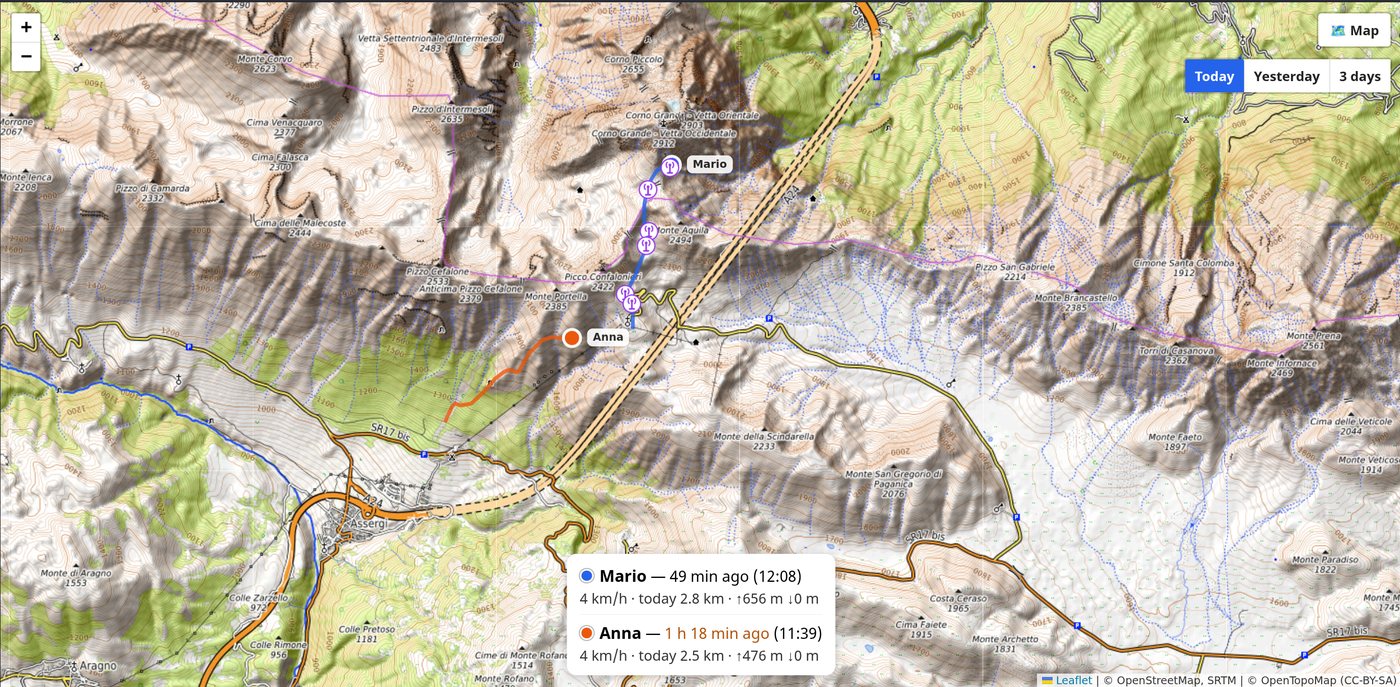
- Shows a map (OpenTopoMap or OpenStreetMap, drawn with Leaflet, embedded in the binary): one colour per person, today’s track, distance and elevation gain, how long ago the last position arrived, and Today · Yesterday · 3 days buttons. Radio positions are drawn as small antennas.
- Sends an alert the first time each day someone starts moving (more than 150 m from the first point of the day, or above 6 km/h), with the link to the map. Channels are built in: Telegram, email (SMTP), ntfy, a generic webhook, or any command. Several can run at once; failed sends are retried.
- Keeps only a few days of data: one text file per day, deleted after three days. The long-term history of my trips lives elsewhere, with photos and heart-rate data.
Phone and radio: two independent paths
Mobile data is often missing exactly where it matters: a deep valley, a ridge on the wrong side of the mountain. That is where amateur radio helps.
APRS in two sentences. The Automatic Packet Reporting System is a radio amateur network: a radio with GPS sends a short position packet every few minutes (in Europe on 144.800 MHz), digipeaters repeat it and igates forward it to the internet, to the worldwide APRS-IS network you can browse on aprs.fi. Digital voice networks feed it too: DMR radios with GPS through BrandMeister, D-STAR radios through DPRS.
dove connects to APRS-IS read-only (it never transmits), follows the callsigns listed in its configuration and drops their positions into the same track as the phone. On the map radio points are small antennas, and if the last position came by radio the page says so, which usually means the phone has no signal. It decodes uncompressed, compressed and Mic-E reports (what most Kenwood and Yaesu handhelds send), with altitude, speed and the DAO precision extension. I tested the decoder against 824 live packets from central Italy: all 401 position reports matched aprslib.
| Phone | Radio (APRS) | |
|---|---|---|
| Needs | mobile data | an igate, digipeater or DMR/D-STAR repeater within radio range |
| Licence | no | yes: transmitting needs an amateur radio licence and a callsign |
| Points | about every minute, a few metres | every few minutes, about 18 m |
| Privacy | stays on your server | public: anyone can see APRS positions on aprs.fi |
The two paths are complementary and independent: either one is enough. Without a licence or a radio dove simply works with the phone. The only thing they share is the dove server, which must be online. Two caveats: the radio needs a GPS fix (beacons without one say 0,0 and are dropped), and radio coverage depends on the local infrastructure.
Privacy by design
There is no login: the page lives under a secret token in the URL (128 bits, like a sharing link), and everything else answers 404. That was a deliberate choice: in an emergency nobody should have to remember a password. If the link leaks, regenerate the token and the old link stops working. The token never reaches the tile servers (Referrer-Policy: origin), and the page asks search engines not to index it. Data stays on your own machine; only identifiers listed in the configuration are accepted. (Radio positions are the exception by nature: APRS is a public network.)
Configuration
One small INI-style file:
link = https://dove.example.org/
move-m = 150

[people]
mario = Mario
anna = Anna

[aprs]
mario = IZ0ABC-7, IZ0ABC-9

[telegram]
token = 123456789:ABC...
chat_id = -1001234567890

[email]
server = smtp.example.org:587
user = mario@example.org
password = ...
to = anna@example.org, luca@example.org
dove -c /etc/dove/dove.conf -test sends a test alert on every channel and tells you which ones work.
XMPP with OMEMO
At home the alert goes to our family chat room on our own XMPP server, end-to-end encrypted with OMEMO. Go has no ready library for the legacy OMEMO that Conversations uses, so this part is a small optional Python script (omemo-sendxmpp, based on slixmpp-omemo) plugged in through the command channel. Everyone else can ignore it.
Download
- Source: dove-1.0.tar.gz
- Binaries (static, Linux): x86-64 · ARM64 / Raspberry Pi 3-5 · ARMv7 / older Raspberry Pi
- SHA256SUMS
- Installation guide (README): configuration, systemd unit, Caddy/nginx examples, phone setup
- License: GPL-3.0-or-later. Leaflet is BSD-2-Clause.
The page follows the browser language, English or Italian (?lang=en or ?lang=it forces one); the alert text is set in the configuration, so each family can write it in its own language.